


NUTRITION

MENU
  • Home
  • Healthcare professionals
  • Patients
  • Contacts
  • Introduction
  • Estimation of nutritional risk
  • Estimation of nutritional intake
  • Estimation of physical activity
  • Ways of nutritional support
  • References

Estimation of nutritional risk

Malnutrition and protein-energy wasting (PEW) affect most dialysis patients at some stage in their life; KDOQI 2020 recommends routine nutritional assessment using validated screening tools at initial evaluation, quarterly, and after clinical changes to guide dietetic therapy and prevent adverse outcomes.

Body Mass Index

The Body Mass Index or BMI is derived from body weight and height and was designed to provide a measure of weight independent of height.

It can be calculated by the tool below.

BMI CALCULATOR

METRIC units IMPERIAL units
Required field
Not a valid value
Not a valid value
Invalid min value
Invalid max value
Required field
Not a valid value
Not a valid value
Invalid min value
Invalid max value
Required field
Not a valid value
Not a valid value
Invalid min value
Invalid max value
Required field
Not a valid value
Not a valid value
Invalid min value
Invalid max value
Required field
Not a valid value
Not a valid value
Invalid min value
Invalid max value
{{a.name}}
Required field
clear Clear calculate Calculate
-- BMI

Percentage of Weight Loss

Weight loss is indicative of insufficient energy intake. Therefore the % of weight loss has been associated with nutritional status and clinical outcomes. An unintentional weight loss equal to 5% of the usual body weight is alerting and a weight loss ≥ 10% of the usual body weight is considered clinically significant and has been associated with increased mortality and morbidity.

WEIGHT LOSS CALCULATOR

METRIC units IMPERIAL units
Required field
Not a valid value
Not a valid value
Invalid min value
Invalid max value
Required field
Not a valid value
Not a valid value
Invalid min value
Invalid max value
Required field
Not a valid value
Not a valid value
Invalid min value
Invalid max value
Required field
Not a valid value
Not a valid value
Invalid min value
Invalid max value
clear Clear calculate Calculate
-- Weight Loss Weight Gain

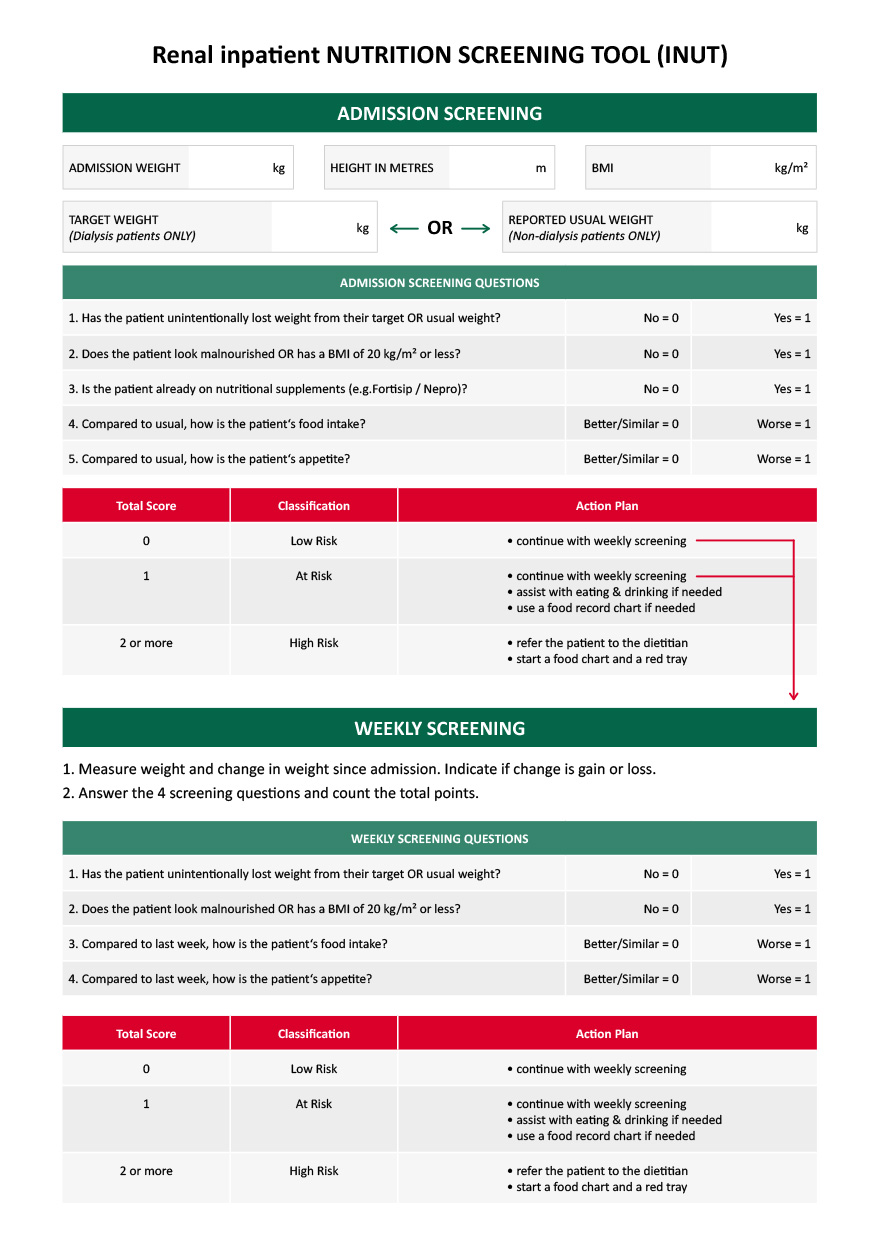
Nutritional screening tools – Hospitalised (Renal iNUT)
(Jackson et al., 2019)

In hospitalized CKD/dialysis patients, Renal iNUT provides rapid risk stratification via weight and intake changes along with having an awareness if patients are already on nutritional supplements.

Download Renal inpatient NUTRITION SCREENING TOOL (INUT) in PDF here.
Nutritional screening tools – Community (MUST)
(Stratton et al., 2004)

MUST evaluate BMI, weight loss, and acute illness in outpatient hemodialysis settings.

MALNUTRITION UNIVERSAL SCREENING TOOL - MUST

‘MUST’ is a three-step screening tool to identify adults, who are malnourished, at risk of malnutrition (undernutrition), or obese. It also includes management guidelines which can be used to develop a care plan. It is for use in hospitals, community and other care settings and can be used by all healthcare workers.

The Malnutrition Universal Screening Tool (MUST) is easy and straightforeward to perform and usually needs less than 3 minutes to complete.

keyboard_double_arrow_right Start the Tool
MALNUTRITION UNIVERSAL SCREENING clear

Works to advance the nutritional care of patients and those at risk from malnutrition in the wider community.

Total Score {{totalScore()}} point{{totalScore() == 1 ? '':'s'}}
navigation
play_circle GET STARTED
STEP 1 - BMI Please fill in the Patient BMI Score which was generated from the BMI Calculator Tool included in this Application
Your BMI kg/m2 > 20 (> 30 Obese) 18.5 – 20 < 18.5
STEP 2 - Weight Loss Please fill in the Patient weight loss which was generated from the Weight Loss Calculator Tool included in this Application
< 5% 5% – 10% > 10%
STEP 3 - Establish Acute Disease effect Please fill in the acute disease effect status of the patient.
If the patient is acutely ill and there has been or is likely to be no nutritional intake for >5 days, please select red option.
If not, please choose green option.
No disease effect Patient is acutely ill. No nutritional intake for > 5 days
RESULT Final score {{totalScore()}} point{{totalScore() == 1 ? '':'s'}}
{{(totalScore() < 1) ? 'YOUR RESULT':''}}
LOW RISK
Routine clinical care

Repeat screening

  • Hospital - weekly
  • Care Homes - monthly
  • Community - annually for special groups e.g. those >75 years

All risk categories

Treat underlying condition and provide help and advice on food choices, eating and drinking when necessary.

Record malnutrition risk category.

Record need for special diets and follow local policy.

Obesity

Record presence of obesity. For those with underlying conditions, these are generally controlled before the treatment of obesity.

{{(totalScore() == 1) ? 'YOUR RESULT':''}}
MEDIUM RISK
Observe

Document dietary intake for 3 days

If adequate - little concern and repeat screening

  • Hospital - weekly
  • Care Home - at least monthly
  • Community - at least every 2-3 months

All risk categories

Treat underlying condition and provide help and advice on food choices, eating and drinking when necessary.

Record malnutrition risk category.

Obesity

Record presence of obesity. For those with underlying conditions, these are generally controlled before the treatment of obesity.

{{(totalScore() > 1) ? 'YOUR RESULT':''}}
HIGH RISK
Treat *

Refer to dietetian, Nutritional Support team or implement local policy

Set goals, improve and increase overall nutritional intake

  • Hospital - weekly
  • Care Home - monthly
  • Community - monthly

*) Unless detrimental or no benefit is expected from nutritional support e.g. imminent death.

All risk categories

Treat underlying condition and provide help and advice on food choices, eating and drinking when necessary.

Record malnutrition risk category.

Obesity

Record presence of obesity. For those with underlying conditions, these are generally controlled before the treatment of obesity.

chevron_left {{ steps.length == 1 ? 'START' : 'PREVIOUS STEP' }} {{ steps.length == 3 ? 'RESULT' : 'NEXT STEP' }} chevron_right CLOSE clear

EDTNA/ERCA Secretariat

Uzubaliu 7, Miklusenai, Alytaus r. sav. 62466
Lithuania
E-mail: secretariat@edtnaerca.org
Www: www.edtnaerca.org

Head Office

EDTNA/ERCA, Seestrasse 91, CH 6052 Hergiswil, Switzerland
facebook linkedin twitter instagram